
Rate con review: a grade on every load
The terms read off a rate con or a settlement — detention, TONU, layover, reefer fuel, fines, pay days — set against that week’s diesel and a fair rate, and a letter grade with the reasons.
A rate confirmation says what a load will pay and on what terms; a settlement says what it did pay. Most of what costs you money is in the small print — a detention rate that won’t cover the wait, no TONU if the load is cancelled, nothing about reefer fuel, a fine for a missed check call. LoadTally reads those terms off the page and gives every load a letter grade, with the reasons in plain words.
Where the grade shows
A Grade pill sits beside the load’s status on the Loads board and at the top of the load’s own page. A is green: nothing to worry about. B is fine with a thing or two to watch. C wants a look. D and F are red: the terms are costing you. Tap the pill on the load’s page and the review opens.
A load with no paper to judge yet says Not graded yet in grey instead — it waits for the rate con or the settlement. Tap it on the load’s page and it says how a load gets its grade. Each line on a carrier’s settlement sheet wears a grade too, even before there’s a load for it in LoadTally; tap one open and the same review comes up.
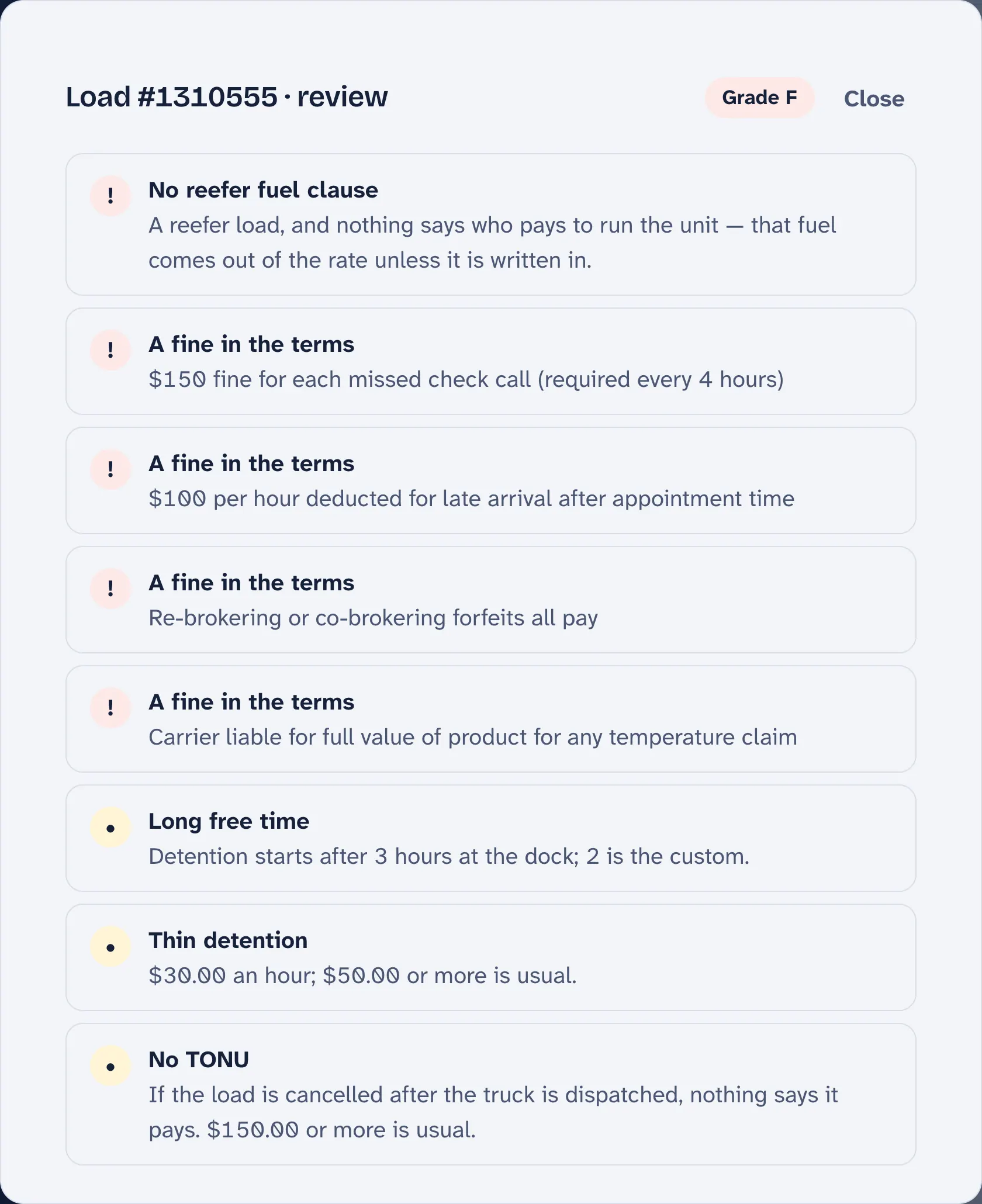
What it reads
Nothing new to do. The rate con comes in the way paperwork always does — a photo, or forwarded to your paperwork address — and a page that prints pay terms gets a second, careful read for them:
- The money. The linehaul, the fuel surcharge or “fuel included”, the total, the miles, and the trailer.
- Waiting. Detention, per hour, and how many hours are free before it starts. Layover, per day.
- Cancelled. TONU — truck ordered, not used — what it pays if the load falls through after the truck is dispatched.
- Who pays for what. Lumpers at the dock, and on a reefer, the fuel to run the unit.
- Getting paid. How many days until it pays, and what quick pay costs.
- Fines and odd clauses. Each one written out, the way the page says it.
A term the page doesn’t state is left blank, not guessed — and a blank is often the finding: no TONU means a cancelled load pays nothing.
Leased to a carrier and never see a rate con? The settlement grades the load instead: your share against the one you agreed, the pay a loaded mile against the floor, and the fuel surcharge against that week’s diesel. What only a rate con says — detention, TONU, layover, lumpers, reefer fuel, pay days, fines — isn’t judged at all, so it costs the grade nothing, and the review says so. When both are in, both are judged, and each finding says which paper it came off.
Against the market
Under the findings, the load is set beside the week it ran: what it paid a mile all-in, the floor for its kind of trailer, the diesel price that week, and what a usual fuel-surcharge schedule would pay a mile at that price. Then the rate con’s terms, line by line, and what the carrier paid, if the settlement is in.
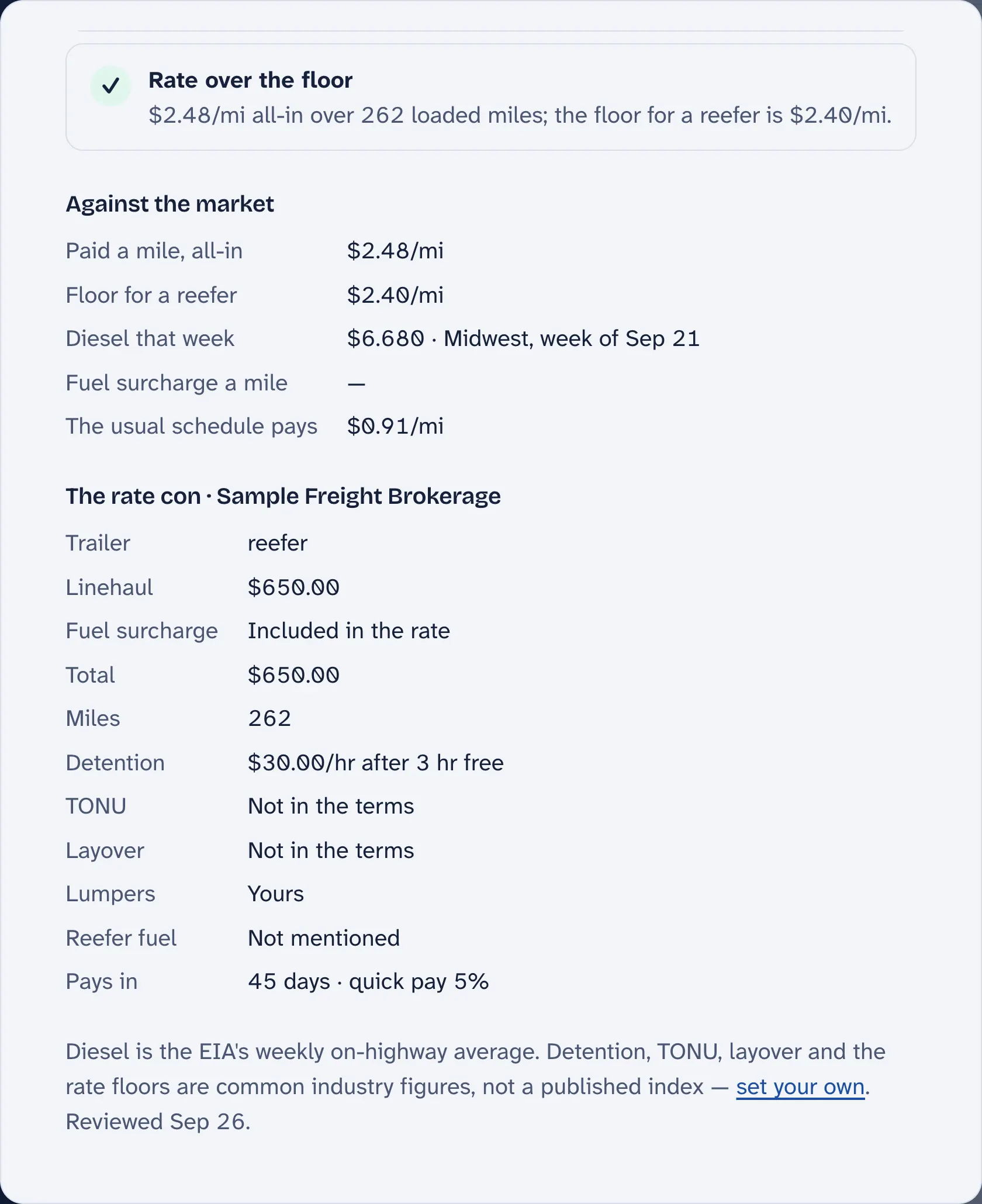
- Diesel is the U.S. Energy Information Administration’s weekly on-highway average, for your region when it has one, brought in every day. A load is judged on the week it shipped.
- The fuel-surcharge schedule is the common one: diesel less $1.25, divided by 6 miles a gallon, for each mile. At $6.53 diesel that is $0.88 a mile.
- The floors are what a loaded mile should pay, all-in: $2.21 for a van, $2.39 for a flatbed, $2.61 for a reefer, to start. The van floor is what a mile cost truckload fleets to run in 2025, with fuel and the driver in it; the flatbed floor is the same for specialized fleets, flatbed among them — the rate is all-in too, so fuel counts once on each side. ATRI, 2026. ATRI prints no reefer figure of its own, so the reefer floor is the van floor and 40¢ more — that 40¢ is LoadTally’s.
- Detention is held against $70.61 an hour — what a truck standing still at a dock costs: the truck and trailer payments, insurance, permits, and the driver’s wages and benefits, which don’t stop while the wheels do. Fuel, repairs, tires and tolls come with the miles, so they are left out. ATRI, 2026.
The industry’s cost of a mile, line by line, is on what it costs to run a truck.
How the grade is worked out
Every load starts at 100. Each rule that counts a lot takes off 15 when it finds something, and each that counts a little takes off 6. 90 and up is an A, 80 a B, 70 a C, 60 a D, and under that an F. Those are where every company starts; the table is the rules as they come.
| Counts a lot (−15) | Counts a little (−6) |
|---|---|
| Under the rate floor | Long free time before detention |
| No detention clause | Thin detention |
| No reefer-fuel clause on a reefer load | No TONU, or a low one |
| A fine in the terms | No layover pay, or a low one |
| A share that isn’t the one agreed | Lumpers left to you |
| A fuel surcharge under 70% of the schedule | Slow pay, or steep quick pay |
| A clause out of the ordinary; a surcharge under 90% of the schedule; no fuel surcharge at all |
What’s good is said too — Rate over the floor, Paid over the floor — so an A shows why it’s an A.
Your own rules
Every rule is yours, under Setup › Load grades. Each one says what it checks, and you pick how much it counts: Counts a lot, Counts a little, or Don’t count. A rule you don’t count still shows its finding on the review, marked Not counted — you still know, it just takes nothing off. The points each takes off and where each letter starts are yours too, and a line under them works an example as you type: “Two that count a lot and one that counts a little: 100 − 30 − 6 = 64, a D.” Save, and the last 45 days of loads are graded again by your rules straight away. Put everything back to the defaults, at the bottom, undoes all of it after asking.
Your own idea of a fair load
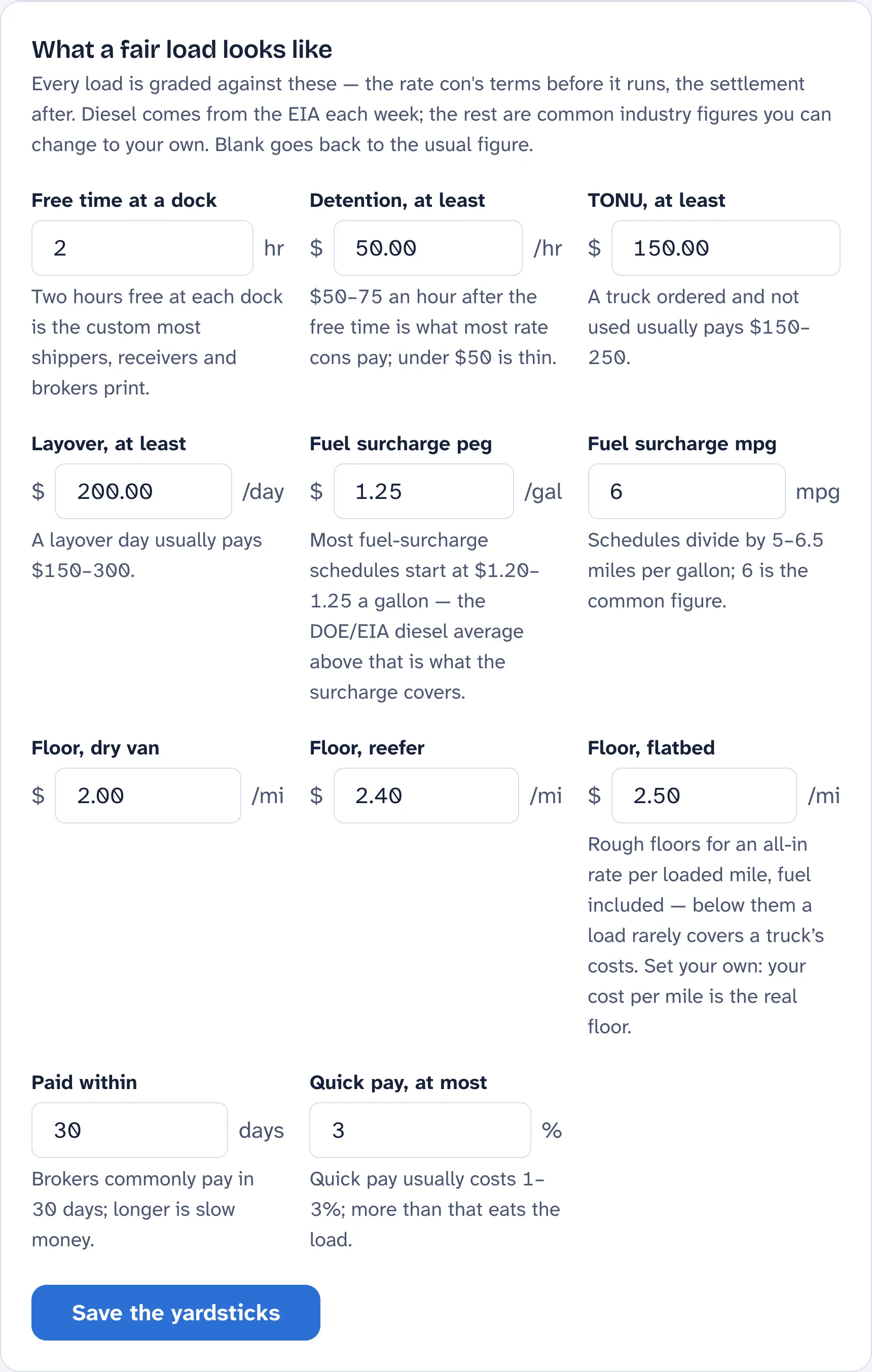
The rate floor and detention start from ATRI’s surveys; the rest are common figures, not a published index — nobody publishes TONU or layover rates for free. All of them are yours to change, under Setup › Load grades › What a fair load looks like: free hours at a dock, the least detention, TONU and layover you accept, the surcharge schedule’s starting price and miles a gallon, the floor a loaded mile for each trailer, the days you’ll wait to be paid, and the most quick pay should cost. Each box says its default and where it comes from, and one you’ve changed says “Yours” beside the default. Change one and the last 45 days of loads are graded again by your numbers.
Read the grade before you say yes. Forward the rate con to your paperwork address as soon as the broker sends it, and the findings are the list of things to ask them to add — a TONU, a reefer-fuel line, detention after two hours.
Only the office sees it. A grade carries what the carrier pays you, so it’s for owners. Drivers never see a grade or a review.