
6 min read
Does the fuel surcharge on your settlement cover the diesel?
The fuel surcharge pays pump price minus a base price, at an assumed mpg, on loaded miles only. One week checked against the fuel card, with the math.
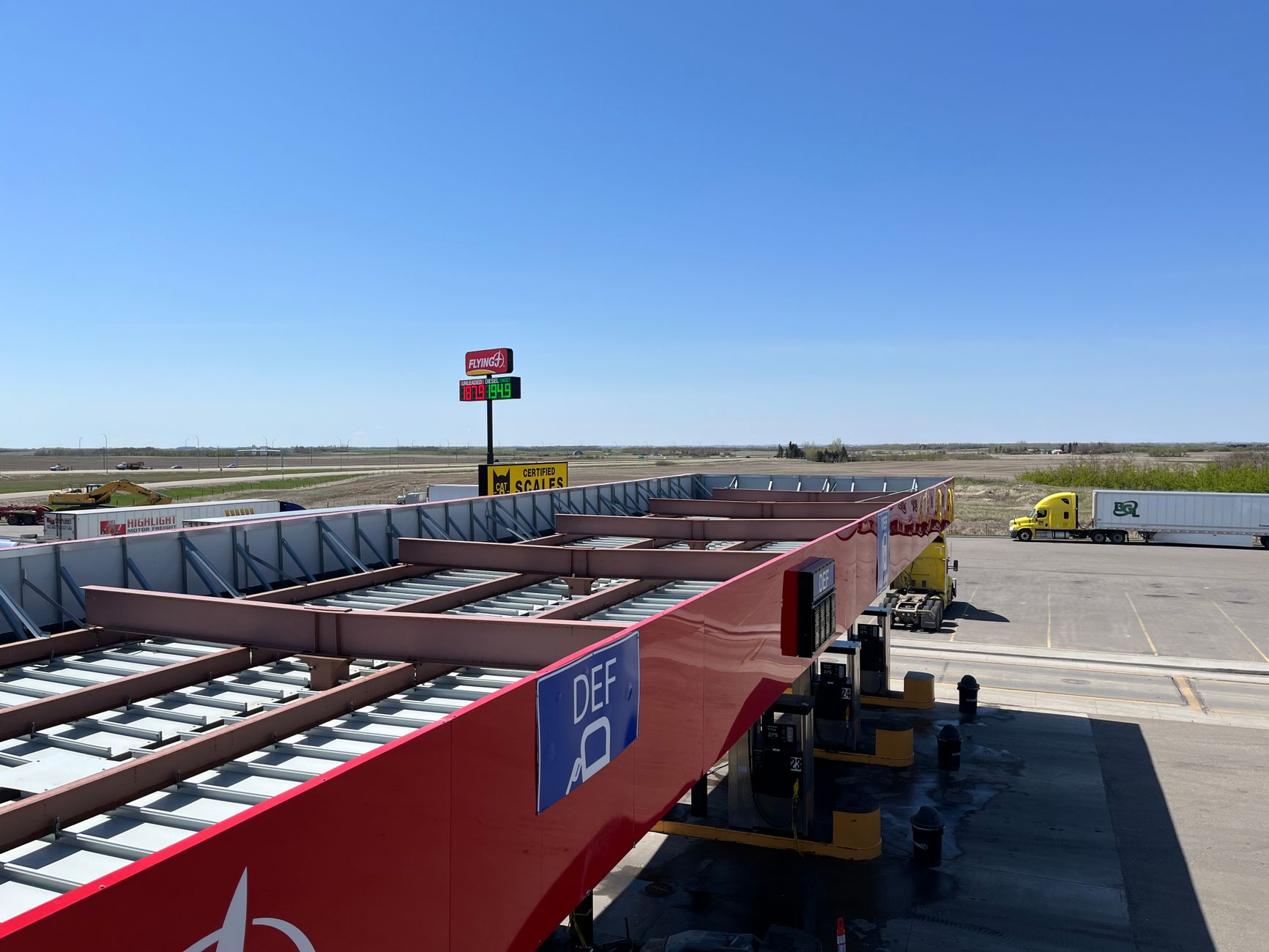
No, and it was never built to. The fuel surcharge on your settlement pays you the part of the pump price that sits above a base price, divided by an mpg the carrier assumes, and only on loaded miles. The base price is supposed to already be inside the line rate you agreed to. So if the surcharge covers about three quarters of your fuel bill in a normal week, the scale is working the way it was drawn. The question worth asking is whether it covers the three places it quietly falls short.
What the line actually is
A fuel surcharge scale has three parts. Ask your carrier for all three in writing.
- The base price. Usually somewhere around $1.15 to $1.30 a gallon. Diesel below that price earns no surcharge at all.
- The assumed mpg. Often 5.0 to 6.5. This is the number the carrier says a truck gets. It is not your number.
- The price it reads. Most carriers use the national average diesel price published each Monday and hold it for the week.
The math is pump price minus base price, divided by assumed mpg. That gives cents per mile. Then it is multiplied by loaded miles.
Say the price for the week is $6.53, about where the national average sat the week of September 21, and the base is $1.25. That leaves $5.28 a gallon. At an assumed 6.0 mpg:
$5.28 ÷ 6.0 = $0.88 per loaded mile
That is the whole scale. On most scales empty miles get nothing, because the carrier pays you by the loaded mile in the first place. Whether you pay your driver for empty miles is your own rule, and it has nothing to do with this line.
One week, four loads
This is an example with round numbers. Dave runs one truck leased on, and last week he ran four loads.
Loaded miles: 612 + 488 + 734 + 410 = 2,244 Empty miles between them: 306 All miles: 2,550
Surcharge at $0.88 a loaded mile:
- 612 × $0.88 = $538.56
- 488 × $0.88 = $429.44
- 734 × $0.88 = $645.92
- 410 × $0.88 = $360.80
$538.56 + $429.44 + $645.92 + $360.80 = $1,974.72 collected
Now the fuel card. The truck averaged 6.4 mpg for the week, over all miles:
2,550 ÷ 6.4 = 398.44 gallons
The part of those gallons above the base price, which is the part the surcharge is meant to answer for:
398.44 × $5.28 = $2,103.76
$2,103.76 − $1,974.72 = $129.04 short, or 5.8 cents a loaded mile.
And the whole fuel bill, since that is what actually came off the settlement:
398.44 × $6.53 = $2,601.81
The surcharge covered $1,974.72 of it, or 76 percent. The line rate has to carry the other $627.09. That is not a mistake. It is $498.05 of base-price fuel, which the rate is supposed to include, plus the $129.04 gap. If you judge a lane on the line rate alone, you have already forgotten the diesel.
The three places it falls short
Dave's $129.04 did not come from nowhere. Three things pushed it, two down and one up.
Empty miles collected nothing. Those 306 miles still burned fuel: 306 ÷ 6.4 = 47.81 gallons, and the above-base part is 47.81 × $5.28 = $252.44. That is the biggest hole, 11.2 cents a loaded mile.
Running better than the scale put money back. The scale assumes 6.0. On 2,244 loaded miles that is 374.00 gallons. At a real 6.4 mpg, those loaded miles took 350.63 gallons. The 23.37 gallon difference is worth 23.37 × $5.28 = $123.39 in your favor.
Those two are the whole gap: $252.44 − $123.39 = $129.05, a cent off the $129.04 from rounding the gallons. Then there is one more nobody mentions.
DEF carries no surcharge at all. It is not diesel, so it is not in the scale. Ten gallons at $3.09 is $30.90 for the week, and every cent of it comes out of the line rate.
$129.04 + $30.90 = $159.94 down for the week, 7.1 cents a loaded mile.
The break-even deadhead number
Here is the part you can run on any week, without knowing the price of fuel. The surcharge breaks even when your empty miles, as a share of all miles, equal:
1 − (the carrier's assumed mpg ÷ your actual mpg)
At 6.4 mpg against a 6.0 scale: 1 − (6.0 ÷ 6.4) = 0.0625, or 6.25 percent deadhead. On 2,244 loaded miles that is about 150 empty miles before the surcharge stops covering the above-base fuel.
Dave ran 306 empty out of 2,550, which is 12 percent. Double the break-even. That single number tells him more about the week than the total on the check.
Notice the price of diesel is not in that formula. A high week and a low week have the same break-even. What the price changes is the size of the hole once you are past it: at $6.53, every empty mile at 6.4 mpg burns 82.5 cents of above-base fuel the surcharge never pays. Only your mpg and the carrier's assumed mpg move it.
What a tenth of an mpg is worth
The surcharge does not change when your mpg changes. Only the fuel bill does. Same week, same four loads, same $1,974.72 collected:
| Your mpg | Gallons for 2,550 mi | Above-base fuel | Surcharge paid | Short by |
|---|---|---|---|---|
| 6.4 | 398.44 | $2,103.76 | $1,974.72 | $129.04 |
| 6.0 | 425.00 | $2,244.00 | $1,974.72 | $269.28 |
| 5.8 | 439.66 | $2,321.40 | $1,974.72 | $346.68 |
From 5.8 to 6.4 is $217.64 in one week. Forty-five weeks like that one is $9,793.80. That is the same money whether it comes from idle time, tire pressure, or a driver who runs 68 instead of 75.
Check it against the fuel card, not against memory
Your settlement has a fuel surcharge on the pay side and a fuel card deduction on the deduction side. Nobody puts them next to each other. Do it once a month.
- Add the surcharge lines for four settlements.
- Add the fuel card deductions for the same four.
- Get gallons and total miles for the same stretch, and divide for your real mpg.
Watch the timing. Fuel bought on Thursday often shows up on next week's deduction, so one week alone can look wrong by a hundred dollars for no reason. Four weeks smooths that out.
Carriers differ, and you should write yours down and use it the same way every time. Some pay the surcharge on all dispatched miles, empty included, which kills the biggest hole. Some pay a flat cents per mile that moves monthly instead of weekly. Some pay a percentage of the line haul, which is not really a fuel scale at all. Ask which miles yours pays on, what the base price is, and what mpg it assumes. If a dispatcher cannot tell you, ask settlements. The fuel surcharge is yours, by the way — it is truck revenue, not driver pay, and it does not belong anywhere on your driver's pay sheet.
Do this week
Pull the last four settlements and write two numbers on a sheet of paper: total fuel surcharge collected, total fuel card deducted. Then call and get your carrier's base price and assumed mpg, and figure your break-even deadhead percentage from your own mpg. Once you know that number, you can look at a load offer with 180 empty miles in front of it and know what it costs before you say yes.